Wednesday, May 1, 2013

* ΠΡΟΣΕΧΩΣ / COMING SOON


"COMING SOON" is an installation that aims to reinterpret the existing urban landscape and enhance the discourse on open air public spaces as well as their engagement to the community. The intervention acts as an occasion that triggers the process of transformation of abandoned spaces into active places of leisure and communication. 
The action takes place in the abandoned open-air cinema of Messolonghi and attempts to restore hope for reclaiming lost spaces of the city with a nostalgic, cinematic mood. A wired frame made of reused cables, typically used to weave the spectators' chairs in Greek summer cinemas, displays an inviting and promising message and mediates the cinematographic plot to a storytelling installation. The common perception of Messolonghi, a mere reflection of the city in the lagoon is reversed. The traditional fishing boat, reminder of the lagoon, relocates the field of interest within the city, and the installation becomes an invitation to an exciting and unexpected interweaving of actions and relationships within the public realm.

***
Η εγκατάσταση "ΠΡΟΣΕΧΩΣ" παροτρύνει τους κατοίκους της πόλης να ευαισθητοποιηθούν και να εξοικειωθούν με το δημόσιο χώρο και τους τόπους συνύπαρξης και συναναστροφής. Επαναφέρει την ελπίδα για την ανάκτηση των χαμένων χώρων της πόλης με μια νοσταλγική, κινηματογραφική διάθεση.
Η δράση λαμβάνει χώρα στο εγκαταλελειμμένο θερινό σινεμά του Μεσολογγίου και επιχειρεί να φέρει στο προσκήνιο το χαρακτήρα του θερινού σινεμά: τη συνάθροιση, τη συναναστροφή, την επικοινωνία. Το μέσο για την κατασκευή είναι το ευτελές υλικό καλώδιο, υπόλειμμα από καθίσματα αντίστοιχα με εκείνα των θερινών κινηματογράφων. Η πλοκή διαδραματίζεται κυριολεκτικά στην οθόνη με τη δημιουργία δικτυώματος από καλώδια, δημιουργώντας μια εικόνα που παραπέμπει στα δίχτυα των ψαράδων. 
Με την εγκατάσταση αυτή επιχειρείται μια αντιστροφή της παραδοσιακής εικόνας του Μεσολογγίου, της πόλης που αντικατοπτρίζεται στη λιμνοθάλασσα. Η προσοχή τώρα στρέφεται στην πόλη. Η γαΐτα, ως υπενθύμιση της  θάλασσας, τοποθετείται μέσα στην πόλη σηματοδοτώντας εκ νέου το πεδίο ενδιαφέροντος. Τα δίχτυα πλέκουν την εγκαταλελειμμένη μέχρι πρότινος οθόνη του κινηματογράφου, ενεργοποιώντας έναν παρατημένο δημόσιο χώρο.
Το αποτέλεσμα της εγκατάστασης είναι η δημιουργία ενός πραγματικού και μεταφορικού δικτυώματος ανθρώπων, ιδεών, οραμάτων. Η κατασκευή, με ένα αισιόδοξο μήνυμα, προσκαλεί τους κατοίκους σε μια δημιουργική εμπλοκή και κοινωνική όσμωση, καλώντας τους να επανεξετάσουν τη σχέση και το ρόλο τους μέσα στην πόλη.    


Μιὰ μένα εἶναι ἡ μοίρα μου, μιὰ μένα εἶν᾿ ἡ χάρη μου,
δὲν γνώρισα κι ἄλλη.
Μιὰ θάλασσα μέσα μου σὰ λίμνη γλυκόστρωτη
καὶ σὰν ὠκιανός ἀνοιχτὴ  καὶ  μεγάλη.
Κ. Παλαμάς

Η εγκατάσταση πργματοποιήθηκε στα πλαίσια της έκθεσης Φαντάσου την πόλη: Μεσολόγγι 2013.

Monday, April 15, 2013

Nests of light|from Russia with love*


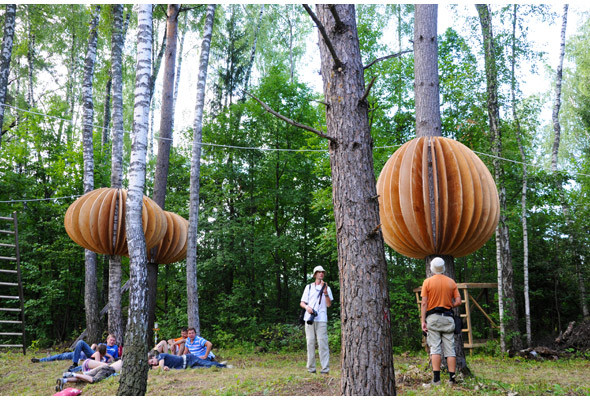
Is a nest on a tree already architecture or still a forest? The project was created for the purposes of the Archstoyanie festival in 2012 and responds to the question above: A manmade nest occupies a position in between: it is of evidently artificial origin, but “lives” on a tree and does not exist without it, it shines – but in the forest, where there is no one to shine for.The light gives the natural space a status of being habitable, developed by man. The clearing becomes a square, the tree becomes a street-lamp.


As compared to its dweller, a nest is more like furniture than architecture. A nest of light in the forest reminds us of interiors, of green suits and halls, corridors and vaults, of all the architectural undertakings that can be met in an ordinary forest. And then, by the power of imagination, a forest becomes a park, and the locality – a landscape! http://arch.stoyanie.ru/en/objects/nests-of-light                     

Η εγκατάσταση που δημιουργήθηκε στα πλαίσια του Archstoyanie festival στη Ρωσία σηματοδοτεί ένα δάσος με φωτεινές φωλιές, μετατρέποντας με διακριτικό τρόπο ένα ακατέργαστο φυσικό τοπίο σε ένα πανηγυρικό τόπο.  

Thursday, April 11, 2013

City*DNA


Artist Lu Xinjian draws abstract images of city patterns by interpreting aerial views form Google earth to a set of straight and curved lines, circles, crosses and rectangles. Illustrations depict cities such as London, Barcelona, Madrid, Beijing, Kyoto, Los Angeles and many more. Colors applied are derived from the national flag of each city creating a vibrant and distinctive blueprint. The viewer is indroduced to the genotype and vibe of a real place - in architectural terminology - its City DNA. The artist, through an abstract manifestation, suggests the interconnectivity between human footprint and urban development and welcomes a reevaluation on our perception of the existent spaces and their relation to one another. 
***
London


Barcelona
Beijing
Kyoto 
Manhattan 

Lu Xinjian χρησιμοποιώντας απλά γεωμετρικά σχήματα και χρώμα δημιουργεί μία αφαιρετική απεικόνιση της εναέριας θέασης πόλεων όπως το Λονδίνο, η Βαρκελώνη, η Μαδρίτη, το Πεκίνο, το Κιότο, και το Λος Άντζελες. Ο θεατής παρακολουθεί τη γραφική αναπαράσταση και ερμηνεία ενός ζωντανού οργανισμού - όπως υπονοεί και ο τίτλος της σειράς city DNA - και εμπλουτίζει την αντίληψη και προοπτική του για τη σύγχρονη πόλη. 
***

Athens
Brussels
Madrid  
 Rome
Munich
 Zurich
Venice
Milano
Los Angeles
Las Vegas  

***

Tuesday, February 26, 2013

*Voyage installation at Canary Wharf


Voyage installation took place in the Middle Dock of Canary Wharf in London, designed by artists Aether & Hemera. The installation consists of three hundred floating "paper boats", encasing colored dynamic LED lights that come alive at night. The artists have named their work Voyage, a word which comes from Latin "viaticum", meaning provision for travelling. According to them, the aim of the artwork is to allow viewers to travel and sail with absolute freedom, to all places they care to imagine. 

Voyage installation is designed to be an interactive experience; people can engage with it and impact on the behavior of the lights from their mobile phones. Each boat is designed to resist to waves and wind staying upright with a floater and a stabilisation weight. They are connected to the boats in their proximity through heavy-duty threads. The individual boats are translucent elements folded from polypropylene sheets, a fully recyclable material. Τhe LEDs are embedded inside the sails and are programmed for showing light effects. 

***

Η εγκατάσταση Voyage πραγματοποιήθηκε στο Canary Wharf στο Λονδίνο, σχεδιασμένη από το δημιουργικό γραφείο των Aether & Hemera. Αποτελείται από τριακόσια πλεούμενα "χάρτινα καραβάκια" με δυναμικούς φωτισμούς LED, που ζωντανεύουν τη νύχτα. Οι καλλιτέχνες ονόμασαν το έργο τους Voyage, μια λέξη που προέρχεται από τη λατινική viaticum, που σημαίνει διάθεση για ταξίδι. Σύμφωνα με τους δημιουργούς, ο στόχος της εγκατάστασης είναι να επιτρέψει στους θεατές να ταξιδέψουν και να σαλπάρουν με απόλυτη ελευθερία σε οποιοδήποτε μέρος φαντάζονται. 

Η εγκατάσταση είναι σχεδιασμένη έτσι ώστε να αποτελεί μια διαδραστική εμπειρία. Οι περαστικοί μπορούν να αλληλεπιδράσουν μαζί της και να επηρεάσουν το φωτισμό μέσω των κινητών τους τηλεφώνων. Ο σχεδιασμός των καραβιών τους επιτρέπει να αντιστέκονται στα κύματα και στον αέρα και είναι ενωμένα με τα κοντινά τους καραβάκια μέσω χοντρών καλωδίων. Κάθε καραβάκι είναι ημιδιαφανές, διπλωμένο από φύλλα πολυπροπυλενίου, ένα πλήρως ανακυκλώσιμο υλικό. Ο φωτισμός με τα LED είναι τοποθετημένος στο πανί κάθε βάρκας και είναι προγραμματισμένος να σχηματίζει διάφορα σενάρια φωτισμού. 


All photos and info via Aether & Hemera


Friday, February 1, 2013

*Beeramid_ enjoy your weekend

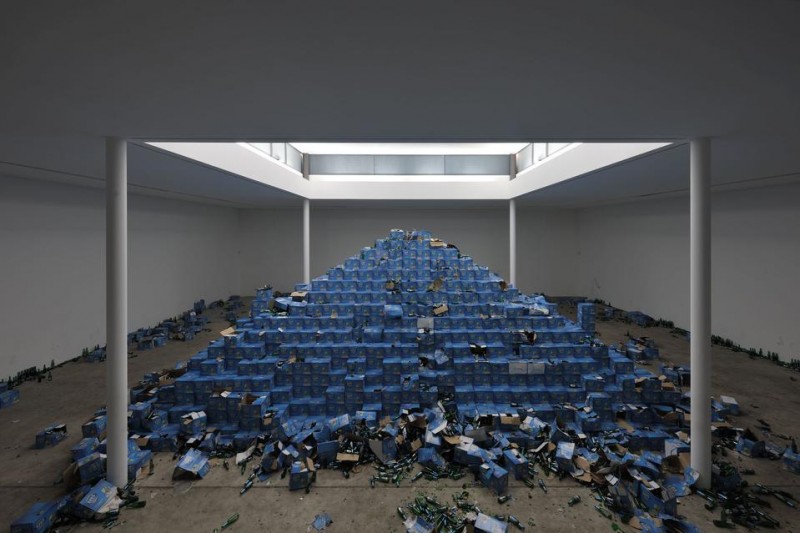
CyprienGaillard explores the absurd aspects of dystopic architectures and their remaining ruins through dilapidation, destruction, demolition, preservation, conservation and reconstruction of architecture. For his exhibition at KW Institute for Contemporary Art in Berlin he has created a new, large-scale piece, which – whilst departing from a prototype of the monument – completes itself in the process.
Similarly to the relocation of the Pergamon Altar, 72,000 bottles of beer of the brand “Efes” have been transported from Turkey to Germany.The cardboard boxes filled with bottles form the even steps of the pyramid. By using the monument – by climbing the sculpture and drinking the beer – its destruction is already initiated….Along the lines of the gradual destruction of the sculpture the alcohol gradually dispels and destroys both body and mind. 
The physical hangover is also an architectural one, from which one has to recover.”


Ο Cyprien Gaillard σχολιάζει με χιούμορ τη φθορά, καταστροφή, κατεδάφιση, συντήρηση, διατήρηση και αποκατάσταση της αρχιτεκτονικής και της έκθεσής της. Μέσω μίας παράλογης και βάρβαρης πρακτικής - απόσπασης και απομόνωσης  ιστορικών στοιχείων και μνημείων από το φυσικό τους περιβάλλον και της επανατοποθέτησης τους σε ένα ξένο μουσειακό χώρο -  το έργο μεταβάλλεται από ένα ζωτικό κομμάτι της ιστορίας σε ένα απολίθωμα. 
Η beeramid - που πραγματοποιείται στα πλαίσια της Berlinalle- επιχειρεί να ενσωματώσει τη πρακτική της καταστροφής σχολιάζοντας ταυτόχρονα την απόσπαση της βιβλιοθήκη της Περγάμου και την μετακόμιση της στο Μουσείο του Βερολίνου.


via KW berlin

Friday, January 18, 2013

*Private Moon


Private Moon is an ongoing mobile art installation by Russian artist Leonid Tishkov. The idea for the installation came ten years ago when the artist wanted to create a picture of the reality of his favorite painter, Belgian surrealist Rene Magritte. He then brought the moon to the roof of his studio on a skyscraper in Moscow, when, in the his own words: "the moon shone to me personally, and brightened my loneliness". Leonid has traveled the world for ten years, placing the illuminated artificial moon in unexpected places across China, New Zealand, Taiwan, Moscow, Italy, the Arctic, France, Austria and so forth.

***

Η εγκατάσταση Private Moon είναι μια διαρκής μετακινούμενη έκθεση από το Ρώσο καλλιτέχνη Leonid Tishkov. Η ιδέα γεννήθηκε δέκα χρόνια πριν, όταν ο καλλιτέχνης θέλησε να δημιουργήσει μια εικόνα από την πραγματικότητα του αγαπημένου του ζωγράφου, του Βέλγου  σουρεαλιστή Rene Magritte. Ο καλλιτέχνης μετέφερε τότε το φεγγάρι στην οροφή του ατελιέ του σε ένα ουρανοξύστη στη Μόσχα, όπου, με τα δικά του λόγια: "το φεγγάρι έλαμψε σε εμένα προσωπικά και φώτισε τη μοναξιά μου". Ο Leonid έχει ταξιδέψει στον κόσμο τα τελευταία δέκα χρόνια, τοποθετώντας το φωτεινό φεγγάρι σε απροσδόκητες τοποθεσίες στην Κίνα, τη Νέα Ζηλανδία, την Ταϊβάν, τη Μόσχα, την Ιταλία, την Αρκτική, τη Γαλλία, την Αυστία και αλλού.


Wednesday, January 9, 2013

*Rainbow Igloo


Thanks to a clever mother from Edmonton we are likely to stop seeing white igloos! The adventure started from an idea of Brigid Burton, when her daughter Kathleen Starrie and her boyfriend Daniel Gray, an engineering student, came for a winter visit from New Zealand. Wanting to "keep occupied" the friend of her daughter, Brigid, assigned him an original design for the frigid winter days, where often the temperatures reached -31 ° C. Last October she begun filling paper cartons with colored water, left in the cold courtyard and created icy colored bricks. She challenged Daniel to utilize his knowledge by building an igloo with those bricks! With the help of relatives and neighbors, the team spent 150 hours putting 500 frosted multicolored bricks and eventually creating a very impressive igloo!

***

Χάρη σε μια έξυπνη μητέρα από το Έντμοντον είναι πολύ πιθανό να σταματήσουμε να βλέπουμε λευκά igloos! Η περιπέτεια ξεκίνησε από μια ιδέα της Brigid Burton, όταν η κόρη της Kathleen Starrie και ο φίλος της Daniel Gray, φοιτητής μηχανικής, ήρθαν για χειμερινή επίσκεψη από τη Νέα Ζηλανδία. Προσπαθώντας να "απασχολήσει" τον φίλο της κόρης της, η Brigid, του ανέθεσε μια πρωτότυπη κατασκευή για τις παγωμένες μέρες, που συχνά οι θερμοκρασίες έφταναν τους -31 °C. Η Brigid από τον περασμένο Οκτώβρη είχε ξεκινήσει να γεμίζει χάρτινες συσκευασίες τροφίμων με χρωματιστό νερό, τις άφηνε στην παγωμένη αυλή της και δημιούργησε παγωμένα χρωματιστά τούβλα. Έτσι, "προκάλεσε" τον Daniel να αξιοποιήσει τις γνώσεις του κατασκευάζοντας ένα igloo με τα τούβλα αυτά! Με τη βοήθεια συγγενών και γειτόνων, η ομάδα ξόδεψε 150 ώρες τοποθετώντας 500 παγωμένα πολύχρωμα τούβλα και δημιουργώντας τελικά ένα πολύ εντυπωσιακό igloo!